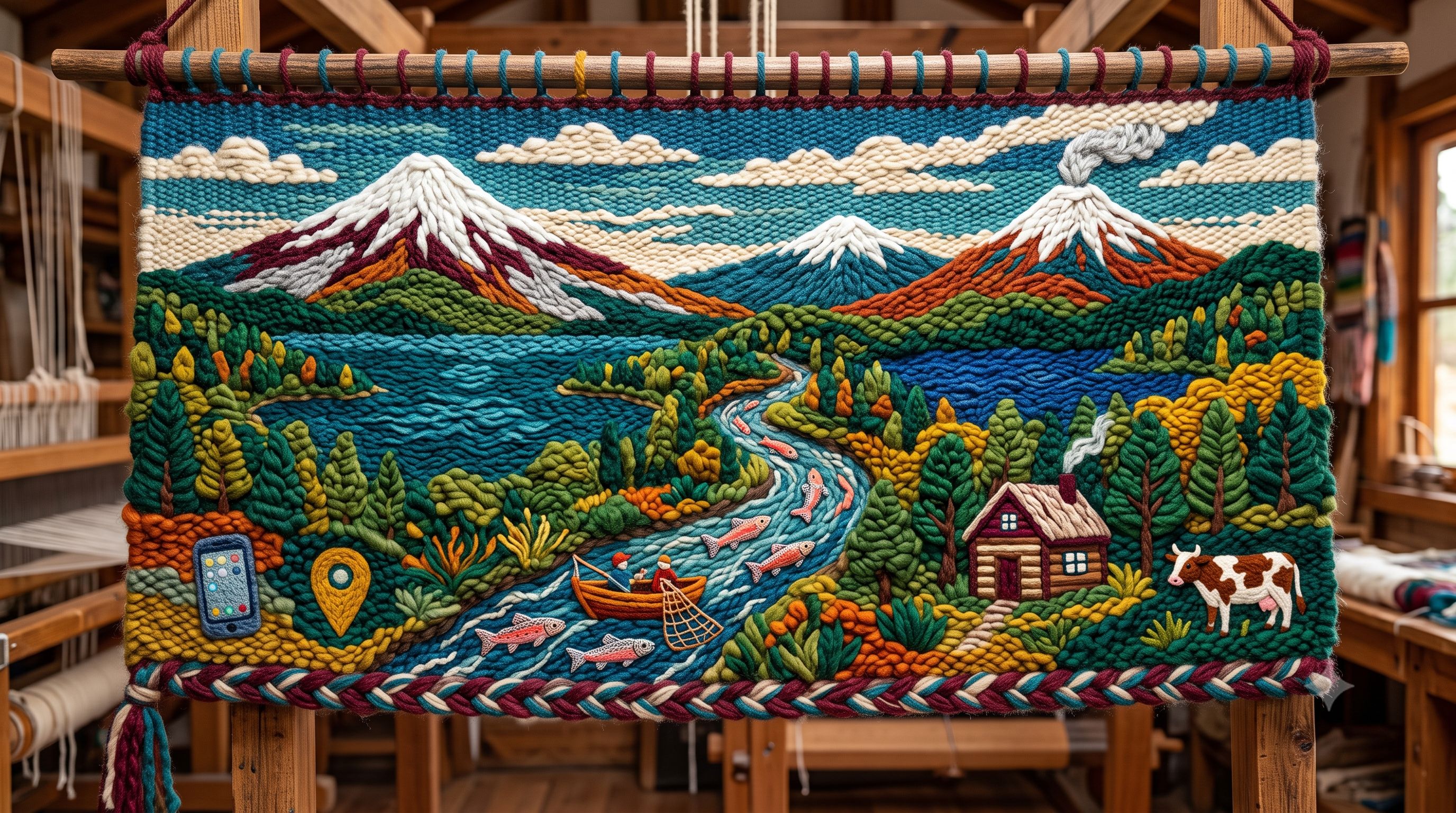
If you've ever tried applying the same Google Ads or Meta strategy that works in Santiago to a business in Puerto Varas, Los Lagos, or Coyhaique, you probably felt it fast: the numbers don't add up the same way. Budgets run out without results, audiences are small, and the kind of relationship local customers expect with a brand is completely different.
It's not that southern Chile is harder. It's that it's different — and if you understand that difference, it becomes a brutal competitive advantage.
💡 The most expensive mistake in regional marketing isn't having a small budget — it's applying mass-market strategies to a trust-based market.
999 CLP per message and €5 per ticket sold: what happens when you adapt strategy to the real market
At El Faro Digital we work simultaneously with a business in Puerto Varas that generates hundreds of monthly messages and with a client in Germany where the cost per ticket sold is €5. Two completely different markets. Two completely different strategies. The same principle: understand the context first, build the solution after.
You don't learn that in a course. You learn it by working seven years in the European market — with brands like Opel — and seven years in Chile with companies like Cerveza Odisea and other clients of different sizes. That combination is what lets us tailor strategies that would cost a Santiago agency twice the time and budget to figure out.
The three real challenges of doing digital marketing in southern Chile
1. Audiences are small — and saturating them is easier than you think
Puerto Montt, Puerto Varas, Osorno, Castro. Together, we're talking about markets of between 50,000 and 200,000 people. When you define an audience on Meta with tight geographic targeting plus specific interests, you can end up with 8,000 to 15,000 people. If your ad runs with an unlimited budget and no frequency cap, within two weeks the same user has already seen it twelve times. Creative fatigue hits faster and harder in the south.
The solution isn't spending more — it's rotating creative more often, segmenting by behavior instead of demographics, and using message or local conversion campaigns instead of mass reach.
2. Southern industries have very specific cycles and audiences
The three big industries in the Los Lagos region are tourism, aquaculture and salmon farming, and livestock and dairy — Osorno is Chile's dairy capital. On top of that you have forestry and lumber, artisanal fishing, and, in recent years, a growing real estate sector driven by migration from Santiago and from abroad.
Each of these industries has its own decision cycle, its own trusted channels, and its own language. An ad for salmon-farm management software isn't built the same way as one for a tourist cabin. One targets operations managers on LinkedIn and Google Search. The other targets tourists planning months in advance using Instagram and Google Maps. Confuse the channels and you're throwing budget away.
3. Closeness builds trust, but limits reach
In southern Chile, local reputation weighs more than any ad. A well-positioned business in Puerto Varas can grow a lot through word of mouth, Google reviews, and organic presence. The problem is that has a ceiling. To grow beyond the local community — reaching Santiago, the rest of Chile, or international tourists — you need a three-audience strategy: local, national, and international, with different messaging for each.
A Patagonian lodge can't talk to someone from Santiago the same way it talks to a German planning their trip nine months in advance and searching for experiences in English. Same destination, three different narratives.
🎯 Having local presence isn't the same as having a strategy. And a national strategy is useless if it doesn't connect with the reality of the territory.
How we build strategy for businesses in southern Chile
The model we apply at El Faro starts from the same diagnosis, regardless of the client's size:
- Defining the three audiences — local (direct conversion and trust), national (Chilean tourists, suppliers, buyers), international (when it applies: European or North American tourists, or global B2B buyers in fishing and aquaculture)
- SEO at all three levels — Spanish-language keywords for the local and national audience, English or German keywords for international audiences. Many southern businesses leave money on the table by not having indexable content in English
- Creative adapted to the channel and the cycle — you don't use the same asset on Meta for awareness as on Google for direct conversion. In small markets, creative quality matters more because each impression relatively costs more
- Message campaigns for local markets — WhatsApp Business integrated, Click to Message campaigns, fast responses. In the south, people call or message before buying. That behavior needs to be leveraged, not ignored
- Efficient budgets with planned creative rotation — instead of increasing budget when performance drops, we rotate creative. In small audiences, that extends a campaign's lifecycle two or three times longer
The warning sign: an agency that offers you the same thing it offers everyone else
If a digital marketing agency proposes the same content strategy, the same minimum budget, and the same campaign structure it proposes to a client in Santiago or Buenos Aires, you have a problem. Not because Santiago is a better or worse market — but because a tourism company in Puerto Varas, a services company for the salmon industry, or an artisanal dairy business in Osorno all have completely different dynamics.
Marketing in southern Chile happens by understanding the territory. Not from an office in Providencia with national data.
🔍 The right question to ask any agency before hiring them isn't "how much do you charge?" but "have you worked before with businesses this size, in this market, with this purchase cycle?" The combination of local experience and a global outlook is what lets you answer that question with concrete cases, not promises. If your business is in southern Chile and you want to grow beyond your community without losing what makes you relevant within it, the conversation starts by understanding where you stand — geographically, and in the market.
📍 Looking for a paid media strategy built for southern Chile? Check out our Paid Media Strategy service.